
Rotary International History
The origins, mottoes, and symbols that define a global service movement.
The Story of Rotary's Mottoes
Service Above Self

The Portland gathering also inspired the motto 'Service Above Self'. During an outing on the Columbia River, Ben Collins, president of the Rotary Club of Minneapolis, Minnesota, USA, talked with Seattle Rotarian J.E. Pinkham about the proper way to organize a Rotary club, offering the principle his club had adopted: 'Service, Not Self'. Pinkham invited Rotary founder Paul Harris, who also was on the trip, to join their conversation. Harris asked Collins to address the convention, and the phrase 'Service, Not Self' was met with great enthusiasm.
The 1989 Council on Legislation established 'Service Above Self' as the principal motto of Rotary because it best conveys the philosophy of unselfish volunteer service.
He Profits Most Who Serves Best
Arthur Frederick Sheldon, the Rotarian whose convention speech inspired Rotary’s secondary motto, 'One Profits Most Who Serves Best' (later 'He Profits Most Who Serves Best'), can be traced back to the early days of the organization.
In 1911, the second Rotary convention, in Portland, Oregon, USA, approved 'He Profits Most Who Serves Best' as the Rotary motto. The wording was adapted from a speech that Rotarian Arthur Frederick Sheldon delivered to the first convention, held in Chicago the previous year. Sheldon declared that 'only the science of right conduct toward others pays. Business is the science of human services. He profits most who serves his fellows best.'
At the 1950 Rotary International Convention in Detroit, Michigan, USA, two slogans were formally approved as the official mottoes of Rotary: 'He Profits Most Who Serves Best' and 'Service Above Self'.
The History of the Four-Way Test
The Four-Way Test was created in 1932 by Rotarian Herbert J. Taylor when he was asked to take charge of a company that was facing bankruptcy.
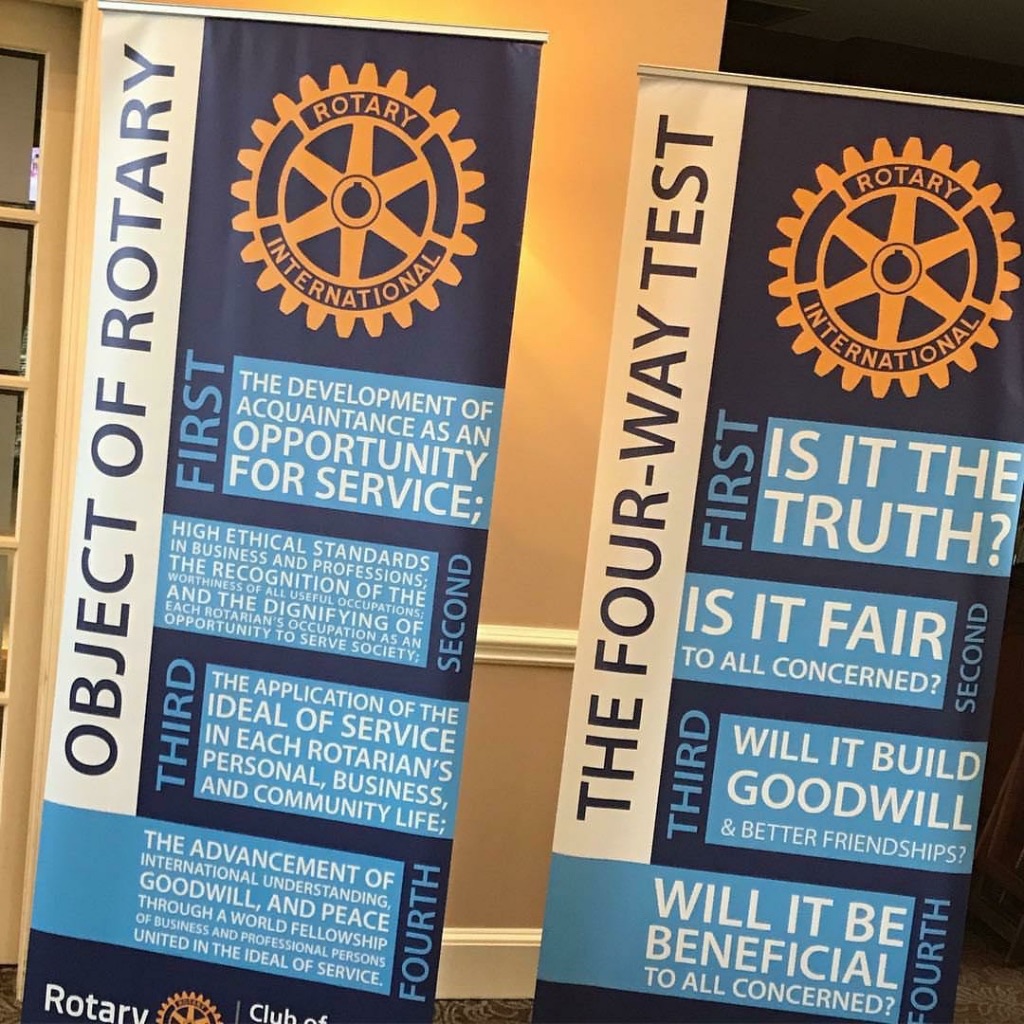
1932: The Bankruptcy Challenge
One of the world’s most widely printed and quoted statements of business ethics is The Four-Way Test, which was created in 1932 by Rotarian Herbert J. Taylor (who later served as RI president) when he was asked to take charge of the Club Aluminum Company, which was facing bankruptcy.
This 24-word test for employees to follow in their business and professional lives became the guide for sales, production, advertising, and all relations with dealers and customers, and the survival of the company is credited to this simple philosophy. Adopted by Rotary in 1943, The Four-Way Test has been translated into more than a hundred languages and published in thousands of ways.
Back in 1932, the Creditors of the Club Aluminum Company assigned me the task of saving the company from being closed out as a bankrupt organization. The company was a distributor of cookware and other household items. We found that the company owed its creditors over $400,000 more than its total assets. It was bankrupt but still alive. At that time we borrowed $6,100 from a Chicago bank to give us a little cash on which to operate.
Building Character & Service
While we had a good product, our competitors also had fine cookware with well-advertised brand names. Our company also had some fine people working for it, but our competitors also had the same. Our competitors were naturally in much stronger financial condition than we were. With tremendous obstacles and handicaps facing us, we felt that we must develop in our organization something which our competitors would not have in equal amount. We decided that it should be the character, dependability and service-mindedness of our personnel.
We determined, first, to be very careful in the selection of our personnel and, second, to help them become better men and women as they progressed with our company. We believed that 'In right there is might' and we determined to do our best to always be right. Our industry, as was true of scores of other industries, had a code of ethics but the code was long, almost impossible to memorize and therefore impractical. We felt that we needed a simple measuring stick of ethics which everyone in the company could quickly memorize.
Formulating the Four Questions
We also believed that the proposed test should not tell our people what they must do, but ask them questions which would make it possible for them to find out whether their proposed plans, policies, statements or actions were right or wrong. Considerable time was spent in developing four short questions which now make up the Four-Way Test: (1) Is it the truth? (2) Is it fair to all concerned? (3) Will it build good will and better friendships? (4) Will it be beneficial to all concerned?
I placed this little test under the glass top of my desk and determined to try it out for a few days before talking to anyone else in the company about it. I had a very discouraging experience. I almost threw it into the wastepaper basket the first day when I checked everything that passed over my desk with the first question, 'Is it the truth?' I never realized before how far I often was from the truth and how many untruths appeared in our company’s literature, letters and advertising.
The Desk Test & Unifying Faiths
After about sixty days of faithful constant effort on my part to live up to the Four-Way Test, I was thoroughly sold on its great worth and at the same time greatly humiliated, and at times discouraged, with my own performance as president of the company. I had, however, made sufficient progress in living up to the Four-Way Test to feel qualified to talk to some of my associates about it. I discussed it with my four department heads. One was a Roman Catholic, the second a Christian Scientist, the third an Orthodox Jew and the fourth a Presbyterian.
I asked each man whether or not there was anything in the Four-Way Test which was contrary to the doctrines and ideals of his particular faith. They all four agreed that truth, justice, friendliness and helpfulness not only coincided with their religious ideals, but that if constantly applied in business they should result in greater success and progress.
Applying the Philosophy & Success
These four men agreed to use the Four-Way Test in checking proposed plans, policies, statements and advertising of the company. Later, all employees were asked to memorize and use the Four-Way Test in their relations with others. The checking of advertising copy against the Four-Way Test resulted in the elimination of statements the truth of which could not be proved. All superlatives such as the words better, best, greatest and finest disappeared from our advertisements. As a result, the public gradually placed more confidence in what we stated in our advertisements and bought more of our products.
The constant use of the Four-Way Test caused us to change our policies covering relations with competitors. We eliminated all adverse or detrimental comments on our competitors’ products from our advertisements and literature. When we found an opportunity to speak well of our competitors we did so. Thus, we gained the confidence and friendship of our competitors.
The application of the Four-Way Test to our relations with our own personnel and that of our suppliers and customers helped us to win their friendship and good will. We have learned that the friendship and confidence of those with whom we associate is essential to permanent success in business. Through over twenty years of sincere effort on the part of our personnel, we have been making steady progress toward reaching the ideals expressed in the Four-Way Test. We have been rewarded with a steady increase in sales, profits and earnings of our personnel.
From a bankrupt condition in 1932, our company has paid its debts in full, has paid its stockholders over one million dollars in dividends and has a present value of over two million dollars. All of these rewards have come from a cash investment of only $6,100, the Four-Way Test and some good hard-working people who have faith in God and high ideals.
Intangible dividends from the use of the Four-Way Test have been even greater than the financial ones. We have enjoyed a constant increase in the good will, friendship and confidence of our customers, our competitors and the public and, what is even more valuable, a great improvement in the moral character of our own personnel. We have found that you cannot constantly apply the Four-Way Test to all your relations with others eight hours each day in business without getting into the habit of doing it in your home, social and community life. You thus become a better father, a better friend and a better citizen.
History of the Rotary Bell & Gavel
The Attendance Contest & Ship Bell
In 1922, U.S. Rotarians organized an attendance contest; the challenge was that the losing clubs would join in giving the winning club a prize. The Rotary Club of New York City was declared the winner and to them was awarded as a prize a bell from a popular patrol boat, which was placed on wood that came from HMS 'Victory', Admiral Nelson's vessel at the battle of Trafalgar.
Order, Discipline & Salutations
Since then, the bell used in Rotary meetings started to represent, as on the ships, order, discipline and the time to guide us through the weekly hour and a half meetings. The bell informs us with its sound the beginning of the Rotary meeting, at which time people present should stand, same as at the end, in order to salute the national and Rotary flags.
The Gavel: Symbol of Authority
The gavel symbolizes the authority invested in the Rotarian elected to the highest position in Rotary, and through him, reminds those present of his authority. When presidents transmit their positions to their successors at the end of their mandate, they give the bell their last hit turning the gavel over to their successor, symbolizing the transfer of authority.
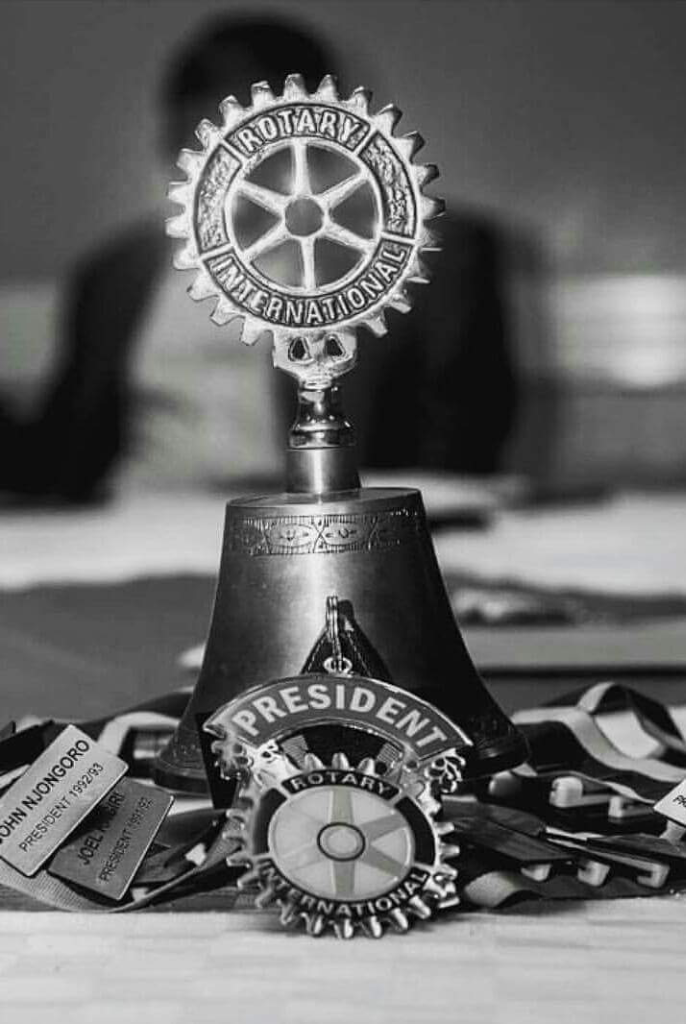 The President's Bell and Gavel representing order and administrative authority transfer.